
Cover illustration: hand-drawn in Procreate and Photoshop. Realistic anatomy, natural behavior, a friendly face.
Case study · K–12 learning design
Todos necesitamos
A bilingual, standards-aligned science kit that helps kindergartners discover what every living thing needs.
ROLE
Learning experience designer, writer, illustrator, art director
AUDIENCE
Kindergarten, ages 5–6, incl. English learners
STANDARDS
NGSS K-LS1-1 · K-ESS3-1
MODEL
5E instructional model
FORMAT
Print-ready, English + Spanish
TOOLS
Procreate, Photoshop, InDesign, Adobe Express, Firefly, GPT‑6
One kit, four kinds of expertise working together.
Pedagogy
5E instructional model
NGSS in three dimensions
Assessment with purposeful distractors
→ Sections 02, 03, 07
Bilingual K–12
Designed for pre-readers and English learners
English leads, Spanish supports
Color-matched vocabulary in both languages
→ Section 05
Illustration
Hand-drawn in Procreate
Research-based realism over cartoon humanizing
Every species true to its habitat
→ Section 04
Responsible AI
GPT-6, Firefly, and Adobe Express extend my own illustrations
Every image reviewed and corrected
Humans decide what to teach
→ Section 06
Kindergarten science materials usually fall into one of three traps.
✕
Charming, but loose
Cute animals that talk and wear clothes. Children remember the joke, not the science.
✕
Accurate, but for readers
Correct content that assumes children can read on their own. Most five-year-olds can’t yet.
✕
Spanish as an afterthought
Bilingual classrooms get translations added at the end, not designed from the start.
THE GOAL
A kit that is scientifically rigorous, works for pre-readers, treats both languages with care, and shows teachers what children actually understand.
Identify
the four basic needs of animals: water, food, air, and shelter.
Distinguish
plant needs: plants make their own food using water, air, and light.
Use a model
to show how an animal’s home meets its needs.
Explain
their thinking aloud with a sentence frame: “The owl needs…”
NGSS, in three dimensions
PE
K-LS1-1 · K-ESS3-1
DCI
LS1.C · ESS3.A
Practices
Models · Data
CCC
Patterns · Systems
Each piece has one job in the 5E model. Together they move children from noticing a pattern to explaining it.

1 · ENGAGE
Anchor poster
Starts with one question: Why do all the animals come to the water? Children notice the pattern before anyone names it.

2 · EXPLORE
Sorting cards
Six living things, five needs. Children discover every animal needs the same things.

3 · EXPLAIN
Read-aloud book
A bilingual book that names the pattern across four habitats, with a teacher guide.
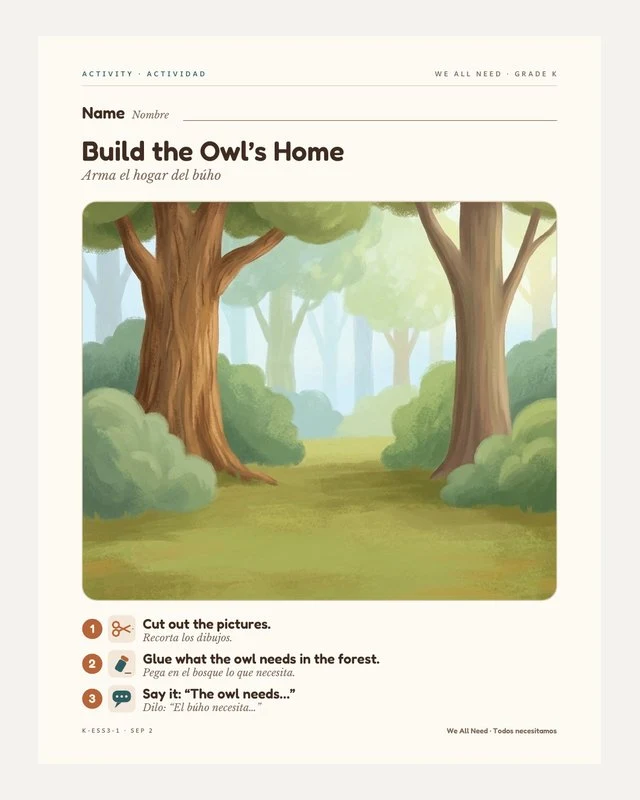
4 · ELABORATE
Build the owl’s home
Cut, glue, and say: children model what the owl needs in its forest.

5 · EVALUATE
Exit ticket
A one-page check with a scoring guide and a next step for each level.

The most visible decision was also a research decision: draw animals that are friendly, but never human.
Hand-illustrated in Procreate
✕ HUMANIZED
Clothes, talking, human actions
Children learned fewer real facts and were more likely to give animals human traits.
✓ REALISTIC
True anatomy, natural behavior
Children learned more facts and applied them to real animals.
THE EVIDENCE
In a study with 3- to 5-year-olds, books with realistic animals led to more factual learning than the same content with humanized animals. Later reviews of picture-book research point the same way: realism helps young children transfer what they learn to the real world.
Ganea, Canfield, Simons-Ghafari & Chou (2014), Frontiers in Psychology · Strouse, Nyhout & Ganea (2018), Frontiers in Psychology
How I applied it
Accurate bodies and natural behaviors: each animal drinks its own way.
Gentle, expressive faces to build connection, without clothes or speech.
One real phenomenon: every animal and plant belongs to a dry-season savanna waterhole.
Spanish was designed in from the start, not translated at the end. The visual system does half the language work, so every child can follow, whatever language they speak at home.
ONE ICON · ONE COLOR · TWO LANGUAGES
agua
comida
aire
refugio
luz · plants
SENTENCE FRAME, SPOKEN ALOUD
The owl needs ______.
El búho necesita ______.
Children complete the frame aloud with a need card, in English or Spanish.
English leads, Spanish supports, on every page and card.
Key words color-matched in both languages, so children connect them at a glance.
Icons carry meaning without reading, for pre-readers and English learners alike.
Answers can be drawn, glued, or spoken, in either language.
AI was one tool in a professional workflow, not the author. I drew the characters by hand, used AI to extend them into a consistent set, and finished every piece in professional design tools.
HUMAN
01
Original illustration
I sketched and painted every character by hand, with accurate anatomy and natural behavior.
Procreate
AI-ASSISTED
02
Extend the set
Starting from my illustrations, AI helped generate the card artwork and the cover in the same style. I selected, corrected, and rejected outputs.
GPT-6
Adobe Firefly
Adobe Express
Icons from Adobe Express, recolored to the need palette.
HUMAN
03
Retouch and color
I fixed details, matched colors to the need palette, and checked scientific accuracy in every image.
Photoshop
HUMAN
04
Layout and print
I laid out every piece with a shared grid and type system, with bleeds and crop marks for print.
InDesign
THE RULE
The most important decisions were not visual. They were about what a five-year-old can do and what a teacher needs to see.

DECISION 01
WHY
Most five-year-olds do not read independently, and many are learning English. If an instruction needs reading, the child depends on an adult and the activity stops being theirs.
HOW IT SHOWS
✓
One icon, one color, and one word for each need, in every piece.
✓
One clear action per step, each with a pictogram: cut, glue, say.
✓
Answers are drawn, glued, or spoken, never required in writing (CCSS W.K.2).
✓
English leads, Spanish supports, with key words color-matched in both.
DECISION 02
WHY
If every option were a correct need, children would circle everything and teachers would learn nothing. The exit ticket has to separate real understanding from guessing.
HOW IT SHOWS
✓
A toy and a hat act as purposeful distractors that separate needs from wants.
✓
Light appears only with plants, so it is learned as a plant need.
✓
The scoring guide asks teachers to probe reasoning, not just count answers.
✓
Three levels, each with a next step for the teacher.

A warm palette drawn from the savanna, a small type system, and print-ready production with bleeds and crop marks. Student worksheets stay clean and ink-light, because teachers print them.
ONE COLOR PER NEED
Water
#3B7EA8
Food
#5E8C31
Air
#3E9E9A
Shelter
#B5603A
Light
#D9A02B
for plants only
The same color, icon, and word mark each need in every piece, in both languages.
THREE TYPEFACES, THREE ROLES
Fredoka · headings and child-facing words
Cherry Swash · story
Libre Baskerville · teacher text

The read-aloud: one animal, one need per page.

MOCKUP
Packaging and card finish, designed as a product a school could order.

The teacher guide: NGSS alignment, vocabulary, and a page-by-page read-aloud guide.
Open each piece as it was designed for the classroom.


Four kindergartners used the kit with their teacher, who shared her observations afterward. Her feedback shaped the final materials.
Observations reported by the teacher. Small informal test, not a formal study.
Attention held
The illustrations kept children focused, including children who usually struggle with attention.
Curiosity drove the book
Children were eager to see which animal came next, a sign the repeated pattern was working.
Needs versus wants was clear
No child circled the toy on the exit ticket: the difference between needs and wants landed.
Complete standards-aligned sequence
Bilingual read-aloud with a teacher guide
Print-ready sorting cards with packaging
Hands-on modeling activity with cut-outs
Rubric levels, each with a next step
REFLECTION
WHAT’S NEXT
Extend the kit into first grade with 1-LS1-1, how body structures help living things survive, and create a digital version for interactive whiteboards.
LET’S WORK TOGETHER
I design standards-aligned, bilingual learning experiences for schools, publishers, edtech companies, and organizations, from curriculum and assessment design to illustrated, print-ready materials.